SLEEP HYPNOSIS PROGRAM & CD
Sleep Hypnosis
People learn to sleep in the most disturbing, noisy and
uncomfortable places. You have probably seen someone asleep
at a noisy party or in an uncomfortable plane seat. We all
have that ability because we all have the same basic
sleeping mechanism. It is just a matter of learning how to
use it.
We all learnt to sleep as babies and some of
us developed better skills to deal with disturbances than
others. You may have just forgotten how to run your normal
sleeping program, or more likely, switched it off for some
reason. Very often, worry can do this. In this case you need
to accept that your unconscious sleeping mind is best part
of you for problem solving.
Forget to stay awake
There are many hypnotic techniques to aid
sleep and help you to consciously release control and allow
sleep to happen. It cannot be forced.
Sometimes lifestyle, environment, diet and a
whole host of external things can disturb your normal
sleeping habits. Hypnosis can teach you to shut these out.
We do this all the time, like when we filter out the
background chatter in a noisy public place so we can hold a
conversation.
This program will show you what you can do
to change the world around you to create the best sleep
environment. This may be enough on its own. Some of these
suggestions may seem obvious, other less so. The important
thing is to act on them.
If you also try the CD program you will make
all the internal changes in your behavior, the way that you
think and where you focus your mind. Hypnosis is extremely
effective for sleep problems, after all, it is a state of
mind not too far removed from deep sleep.
Before you start you may want to read a
review of the current scientific thinking on sleep. Understanding biological cycles, ultradian rhythms and
brainwave activity during sleep will be useful to help you
identify the source of your disturbed sleep.
Don't let sleep deprivation ruin your life
Sleep deprivation causes irritability, carelessness, poor
concentration and affects our work, social interactions and
the quality of our lives.
You need to deal with sleep problems before
they really start to affect your life.
The first time I see many of my patients
have left seeking help for a long time and have seen their
lives suffer. Probably needlessly as sleep problems are
some of the easiest conditions to treat with hypnosis.
What sort of sleep problem do you have?
If you want to read a quick review of the types of sleep
disorder then follow this link>>>
Sleep Hypnosis Step 1 Hypnotherapy
A good nights sleep will leave you refreshed and your mind
more alert and efficient. Careers benefit, relationships
improve, life is less sressful.
You can't battle poor sleeping habits with
your conscious mind. You have to leave it to the deep
unconscious part of your mind to develop the ability to
sleep. It is within all of us. Just a few hours listening to
the therapeutic suggestions and ideas will help you to
reover your natural sleeping ability.
1. You can recover a good sleep pattern.
2. You can learn to go into a deep relaxed state.
3. You develop techniques to quieten an overactive
mind at night.
4. You can remove negative habits that interfere
with your natural sleeping cycle.
5. You can reduce stress and anxiety.
6. Leave problem solving to your unconscious. It's
much better at resolving conflicts and finding solutions
than your waking self. It does this best at night.
Sleep Hypnosis CD
 |
Sleep Hypnosis - Insomnia CD |

|
We have reproduced the main
two sessions that we use in our Hypnotherapy clinics. Hypnosis is a deeply
relaxing experience that we have enhanced on the CD with psychoacoustic
brainwave technology, deeply relaxing music and the familiar sound of
the human heart.
Relearn how to have a high quality night's sleep. Look forward to going to bed every night. Let your unconscious mind take back control with these powerful hypnotic sessions.
Uses brainwave training technology to ensure the suggestions are delivered deep into your unconscious. You may not remember learning to sleep as a baby, but you did, successfully and it is all stored away in your mind.
You can automatically refocus your thoughts so you do not lie in bed at night with your mind wandering, worrying and going in circles.
You can rediscover that your sleep environment is a calm relaxing place to be. Let your unconscious mind deal with it all and fall to sleep soundly every night. |
|
 |
Plus Bonus Relaxation CD
 |
CD # 2 - Relaxation |

|
Sit back, relax and discover how easily you can drift into a deep hypnotic trance. 40 minutes of this deep relaxation is the equivalent of several hours sleep.
The combination of simple harmonic music, human heart beats, binaural tone technology and the guidance of a trained hypnotic voice will deeply relax anyone and you will find that you awake thoroughly refreshed. You can also choose to do a shorter 20 minute relaxation which works like a very effective power nap.
|
|
 |
Plus Free Bonus CD !
 |
CD # 3 - Hypnosis Software |

|
Virtual Hypnotist is a free, open source, interactive hypnosis program
It includes features such as voice recognition, speech synthesis, subliminal messages, completely customizable scripts (featuring a unique scripting language), videos, audio, and lots more. Its purpose is to simulate a real hypnosis session as much as possible.
|
|
 |
 |
THE SLEEP HYPNOSIS PROGRAM
1 Year 100% Full Money Back Guarantee
CD #1 - Sleep Hypnosis
CD #2 - Relaxation
CD #3 - Hypnosis Software
The Sleep Guide.
|
|
 |
|
SLEEP HYPNOSIS PROGRAM
ORDER TODAY !
ONLY $29.95

Order with confidence on
100% secure servers |
Sleep Hypnosis Step 2 Sunlight
Melatonin induces sleep and is produced in the pineal gland
and in the retinas of your eyes when in darkness. Sunlight
switches off production of melatonin in your retinas and
makes you feel more awake.
It can also help to make your sleeping
environment as dark as possible. Then, when you awake,
immediately open the curtains to wake yourself. It is these
well defined changes from sleep to awake and back to sleep
that help to install good sleeping patterns.
Get out into the sun as much as possible
during the day. If you cannot then invest in a bright light
box. These are devices that create light of an intensity
that compares to sunlight. They actively suppress melatonin
secretion and are used in depression related to insufficient
light exposure (SAD).
Higher levels of melatonin in the blood
increases sleepiness. Melatonin release is controlled by the
amount of sunlight in two ways.
i) Through the eyes. Signals from the retinas travel
directly to the brain, specifically to the pineal gland
that controls your body clock. This releases melatonin
into the bloodstream.
ii) Through the skin by stimulating chemical
production directly into the bloodstream.
Sleep Hypnosis Step 3 Exercise
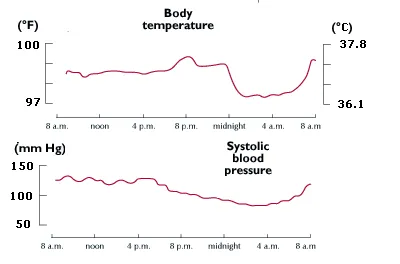
Exercise increases your metabolic rate and your body
temperature. During an average day your temperature
fluctuates by 2 degrees (celsius/centigrade). Higher body
temperatures make you more awake. Exercise at the right
times of the day can boost wakefulness when it is needed.
Ideally first thing in the morning.
Avoid exercise for the 3 hours leading up to
sleep. If you have an active sex life, strange as it may
seem, it may well be worth moving the activity to earlier in
the evening.
Sleep Hypnosis Step 4 Artificial Stimulants
Cut out caffeine, alcohol and tobaccco completely. Not just
before bedtime. Their effects are accumulative. Your body
has to increase metabolic activity to get the toxins out of
your system.
Caffeine
Give up for a few weeks and notice the
positive difference in your energy levels. Withdrawal
symptoms set in after 18 hours and will last a few days.
These can include headaches so drink plenty of water.
Alcohol
For many a blanket ban would be socially
unacceptable. If you have tried everything else then it
would certainly be worth looking at the effect of alcohol on
your specific metabolism. If you are drinking excessively
then you may want to consider a big reduction. See the
addiction program if you are having more serious problems.
Sleep disorders are certainly one symptom of alcoholism.
Nicotine and Smoking
Nicotine and the other chemicals in tobacco
disrupt your sleep in two ways
1. They act as an irritant in your lungs, bronchial
tubes and throat.
2. Nicotine directly stimulates the nervous system
stopping you falling asleep. One cigarette is equivalent
to one cup of strong coffee.
If you need to smoke then certainly stop 3-4 hours before
bedtime.
See the Stop Smoking program for help giving
up.
Sleep Hypnosis Step 5 Water
Drink at least 2 litres of water a day. Dehydration at night
can wake you up as your body has to work harder to recycle
fluid and maintain safe levels. Try not to do too much just
before bedtime as a full bladder will also wake you. Another
good reason to avoid late night drinks, especially alcohol
and diuretics like coffee.
Sleep Hypnosis Step 6 Eating Habits
Don't eat during the 4 hours preceeding sleep. Stomach
digestion will disturb sleep.
If you must eat, you should certainly avoid
sugars and refined carbohydrates in the 3-4 hours before
bedtime. Initially they increase your blood sugar levels and
your body responds by producing insulin to reduce the sugar.
A few hours later you then experience a period of low blood
sugar. If it drops too low you may well wake up and find it
difficult to fall asleep again.
Sleep Hypnosis Step 7 Vitamin B
Deficiencies in Vitamin B will affect your sleep, so you may
need to consider taking a supplement. Find a good
manufacturer as some products can be very ineffectual.
Sleep Hypnosis Step 8 Sleeping Position
Sleep on your back or side. Sleeping on your front will
affect your sleep. Physiologically, it is more difficult to
breathe lying on your front. Obviously don't change this if
you sleep well this way, often people will move position in
the night.
Sleep Hypnosis Step 9 Stress and Anxiety
Stress and anxiety trigger the release of adrenaline. This
in turn disrupts the normal sleep cycle. See the Anxiety
Program pages for help. There are also a lot of CD's and
tapes that are very good for stress reduction.
Sleep Hypnosis Step 10 Mental Focus
Direct your mind towards the idea of a good deep sleep.
Saying to yourself that you are going to sleep badly can
become a self fulfilling prophecy. Hypnosis can help you to
establish good self reinforcement and confidence in your
ability to sleep.
Sleep Hypnosis Step 11 Psychological
Association
Sometimes you can create negative associations with places
or events that will affect sleep. Even a bedroom can become
associated to more physical exertions, a house can have an
'atmosphere', or relationships can produce bad feelings. If
you can change any of these then do so. Hypnosis can also be
effective in reducing the influence of these negative
associations.
Sleep Hypnosis Step 12 Health
Physical pain and illness will inhibit sleep. Hypnosis or
other relaxation techniques can help symptoms to be less
disruptive.
Sleep Hypnosis Step 13 Physical Discomfort
Uncomfortable matresses, room temperature, or poor
ventilation all have a direct effect on your ability to
sleep well.
Make your sleeping environment as
comfortable and fresh as possible. This would also include
using a positive ion generator to combat the effects of air
conditioning and positive ion atmospheric conditions.
Sleep Hypnosis Step 14 Hot Baths
A hot bath or sauna about an hour and a half before bedtime
will be quite energising as it increases your body
temperature. But after about an hour or more the temperature
starts to drop quite rapidly from its artificially high
levels and accelerates the drift into sleep. If it is too
close to bedtime then you will be not be able to sleep until
your body temperature re-equilibrates with your normal
cycle.
Sleep Hypnosis Step 15 Sleeping Pills
Avoid these at all costs. They will break down all your
natural rhythms and make sleep very difficult in the mid to
long term. Your natural rhythms control the amount of REM
and deep sleep you get. Anything that disrupts your natural
balance will probably create a deficit or surfeit in
different parts of your sleep cycle. This is not good.
Sleep Hypnosis Step 16 Routine
Establish regular sleeping and waking times. This will help
to synchronise your circadian rhythms and establish a normal
sleep cycle.
Sleep Hypnosis Step 17 Poor Circulation
If you have poor blood circulation then make sure you stay
warm. One study found that wearing socks to bed helped to
stop people from waking.
Sleep Hypnosis Step 18 Whole Sleep Cycles
Because the natural sleep cycle is on average around 90
minutes, it makes sense to sleep for a number of full cycles
and not wake up half way through a cycle. So you are looking
for periods of sleep such as 4.5 hours, 6 hours or 7.5
hours. This is especially important if you are using an
alarm clock. It relies on you having worked out your natural
your sleep cycle period (it can be extreme between 60 and
120 minutes). In the end it may be down to trial and error.
See what time period works best.
Sleep Hypnosis Step 19 Siesta - Afternoon
Nap
If you look at the circadian rhythm chart again you will
notice the dip in the early afternoon. It seems that there
is a good biological reason for having a nap or siesta in
the afternoon. If you include the reasoning in step 17 then
it would make sense to have a nap of 1.5 hours. Studies at
Harvard found that a group of students that took a 1.5 hour
nap in the afternoon outperformed a control group that did
not.
Sleep Hypnosis Links
Sleep & Insomnia Links
Sleep - The Evolutionary Theory
The current, most widely accepted theory is that sleep is an
'evolutionary leftover'. Prehistorically, mankind was a
hunter-gatherer. We are not nocturnal creatures as we are
not equiped to hunt at night. If we did not sleep, we would
be running around for no particular reason in full sight of
nocturnal predators and would increase our chances of being
eaten. Sleep, especially REM sleep (where the body is
effectively paralysed) evolved to make us still and quiet
during those vulnerable night hours and keep us from harm.
Our natural circadian rhythm of sleep and
wakefulness is nearer 25 hours than 24 hours. Perhaps it was
locked in at this time when the earth's spin was slower and
it exactly matched a day. So our circadian rhythm has to be
continually reset by sunlight. Problems arise when our
exposure to sunlight is intermittent and perhaps non
existent. Something that is quite prevalent in our modern
world of artificial, interior light and long working hours.
Further Reading
There is an interesting article on sleep hypnosis from the Journal of Psychology. - Evans, F. J., Gustafson, L. A.,
O'Connell, D. N., Orne, M. T., & Shor, R. E. Sleep-induced
behavioral response: Relationship to susceptibility to
hypnosis and laboratory sleep patterns. Journal of Nervous
and Mental Disease, 1969, 148, 467-476.
Return from Sleep Hypnosis page
|